Winterizing an Acreage Irrigation System: Why Pumps and Wells Change the Job
Blowing out an acreage irrigation system in the Central Okanagan is a different job from winterizing a suburban yard — pumps, pressure tanks, long mainlines and filtration add specific steps that routine residential service does not cover.
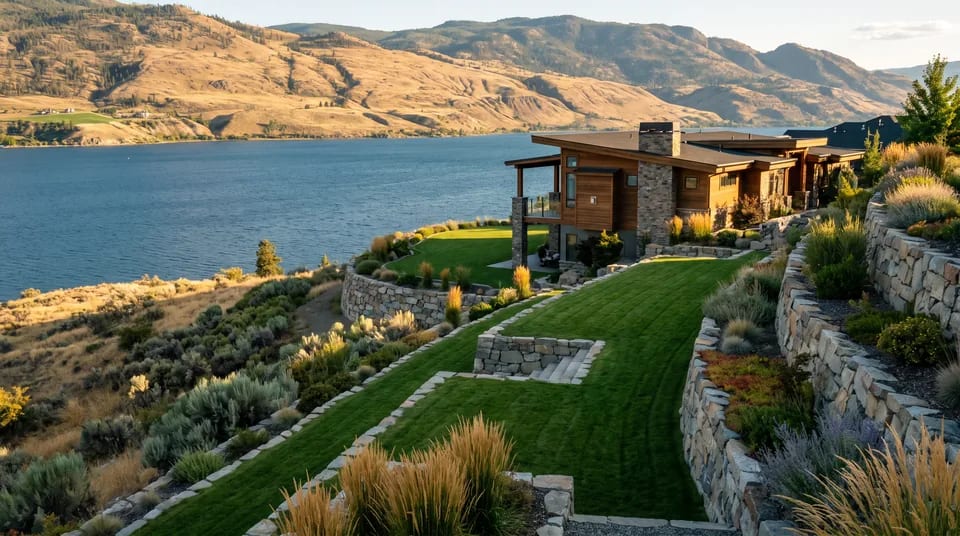
A winterization on a Central Okanagan acreage is not a scaled-up version of a residential blowout — it is a different job with different components, different equipment requirements and different places where things go wrong. The suburban-residential service is well-understood: isolate the supply, blow out the zones, drain the backflow, set the controller off. On an acreage with a well, pump, pressure tank, filtration and a long mainline, half the work is the plumbing above and beside the irrigation itself. Skipping any of it has the same consequence as skipping the blowout proper.
Where acreage systems differ structurally
- A well, lake intake or licensed surface source rather than a municipal connection.
- A pump — either a submersible in the well or a jet or booster pump above ground — that pressurises the system.
- A pressure tank, often large, that stabilises pump output and buffers short demand.
- A pressure switch and sometimes a VFD controller that cycles the pump based on demand.
- Filtration, sometimes multiple stages, specific to the water source — sediment, iron, sometimes UV.
- A mainline that can run hundreds of feet rather than the thirty of a suburban lot.
- Dedicated electrical runs, often with disconnects and sometimes with a shed or small building housing the pump assembly.
Each component is a winterization task
A proper acreage winterization touches every component on that list, not just the zones. The pump needs to be depressurised and, depending on configuration, drained — a submersible stays wet in the well and does not require winterization of its own, but a jet pump or booster above ground does. The pressure tank must be depressurised and often drained through its tank drain. Filtration housings — stage one sediment is the most critical — need to be drained and reassembled dry. The pressure switch is sensitive to being left charged against a drained line, so it is isolated or depowered. The mainline, if above the frost line or exposed at any point, needs to be cleared of water. And every zone needs the same careful blowout the residential service covers.
Why DIY is specifically risky here
A standard residential compressor cannot push air through a long acreage mainline at adequate volume. A missed filter housing cracks. A pump left pressurised through winter develops seal issues. The failures do not look like the failures on a suburban blowout; they look worse, cost more and sometimes mean replacing an entire pump or tank.
The Ellison, South East Kelowna and Joe Rich context
The acreages in these parts of the Central Okanagan are the properties this piece is specifically for. They tend to combine three factors that compound: large irrigated area with high zone count and large mainline, pumped supply with the full equipment stack above, and often elevation that pulls the frost window earlier. South East Kelowna properties on licensed surface sources draw from an active irrigation district whose seasonal operation has its own schedule; Ellison acreages on well supply are self-contained but add the pump complexity. Joe Rich sits at elevation that reduces the window for the whole job on top of all of this.
What a competent acreage winterization visit looks like
- 1Walk the system first: locate every isolation valve, drain, filter and pump component. On an unfamiliar property this is twenty minutes before any air moves.
- 2Shut off the pump at the breaker and depressurise the system; let the pressure tank drain down.
- 3Isolate and drain the backflow assembly, every stage of filtration and any manifolds.
- 4Blow out zones individually, in sequence, with proper regulation at the compressor-to-mainline connection — a larger compressor than residential service needs, usually a tow-behind rig rather than a van-mounted one.
- 5Drain the pressure tank through its tank drain; depressurise it.
- 6If the pump is above-ground, drain it per manufacturer specification. Submersible pumps in a well are generally fine as-is but the pump's house end — switch, pressure gauge, discharge piping — gets drained.
- 7Set the controller off; label any shutoff valves and the breaker so spring commissioning is clean.
- 8Note anything that will need attention at spring start-up: filtration media due, a weeping valve, a cracked riser.
Equipment that comes with the service, not from the garage
A contractor servicing acreages carries a towable compressor rated well above residential — 185 CFM is common, 400+ not unusual on commercial-adjacent work — specifically because a long acreage mainline requires that volume of air to clear in a reasonable time. Smaller compressors cannot do the job regardless of how long they are left running. If a quote on an acreage winterization is unusually low and the contractor is bringing residential equipment, the system is not going to be fully cleared. This is one of the few cases where the cheapest quote is diagnostic rather than frugal.
The spring consequence of skipping any step
Acreage winterization failures tend to show up at spring start-up as: a pump that will not prime because a seal cracked; a pressure tank that will not hold because its bladder failed in freeze; a filter housing cracked at the seam; a mainline leak somewhere between the pump house and the first zone that saturates ground before the irrigation ever runs. Any one of these is a scheduling problem in spring, when every acreage owner in the valley is trying to commission simultaneously. Keeping the problem out of April is almost always cheaper than solving it there.
What to send in a quote request
- The water source — well, licensed surface, irrigation district.
- Whether there is a pressure tank and roughly its size.
- Approximate zone count and whether any zones are drip-only versus spray.
- Filtration stages, if known.
- Backflow assembly type if you can read the label.
- Approximate mainline length between pump house and the first zone.
- Known pain points — weeping, poor pressure, filter frequency — from the season just ended.
Contractors quoting on that information can price close to final before stepping on the property. On an acreage the price-close-to-final matters because this is not a service where a bare phone quote is reliable. The quote form on this platform collects enough of this information to put real quotes in front of you — the piece on how to hire an irrigation contractor elsewhere on this site is worth reading alongside, because the vetting conversation matters more on an acreage than on a straightforward suburban lot.