Lakeview Heights · Westside slope communities
Lakeview Heights Irrigation Installation Quotes
Westside installations have to be designed around the watering window as a hard constraint. Every zone must complete within permitted hours, which usually means more zones running shorter, and slope-plus-sun exposure pushes designs toward drip wherever turf is not essential.
Whether you are irrigating a new lawn, extending into a new garden area or replacing a system that has reached the end of its life, the design stage is where the outcome is decided. Lakeview Heights properties often sit beside working vineyards, and irrigation practice reflects it — which shapes what installation work here usually involves.
Commonly requested here
Installation work on Lakeview Heights properties
- Zone counts designed to complete within permitted watering hours
- Drip specified for all non-turf areas at design stage
- Slope-aware application rates with cycle-and-soak scheduling
- Pressure regulation across sloped zones as standard
- Smart controllers with rain shut-off and seasonal adjustment
Worth knowing
The permitted watering window sets the design ceiling. Total run time for all zones has to fit inside it, so on restricted schedules the answer is more zones of shorter duration rather than fewer long ones.
Issues that come up in Lakeview Heights
- Slope and terracing requiring pressure regulation and careful application rates
- Vineyard-adjacent properties mixing agricultural drip with domestic landscaping
- Older systems in a long-established area, some predating municipal amalgamation
Local context
- Lakeview Heights is established wine country on the slopes above Okanagan Lake, home to a number of well-known West Kelowna wineries.
- The area was historically served by the Lakeview Irrigation District before amalgamation into the City of West Kelowna.
- Sloped, east-facing lots with substantial ornamental and vineyard planting are the norm.
East-facing slopes above the lake catch strong morning and midday sun, and the growing conditions that suit vineyards also mean sustained summer moisture demand.
What to expect
Typically part of the job
- Drip specified for all non-turf areas at design stage
- Slope-aware application rates with cycle-and-soak scheduling
- Pressure regulation across sloped zones as standard
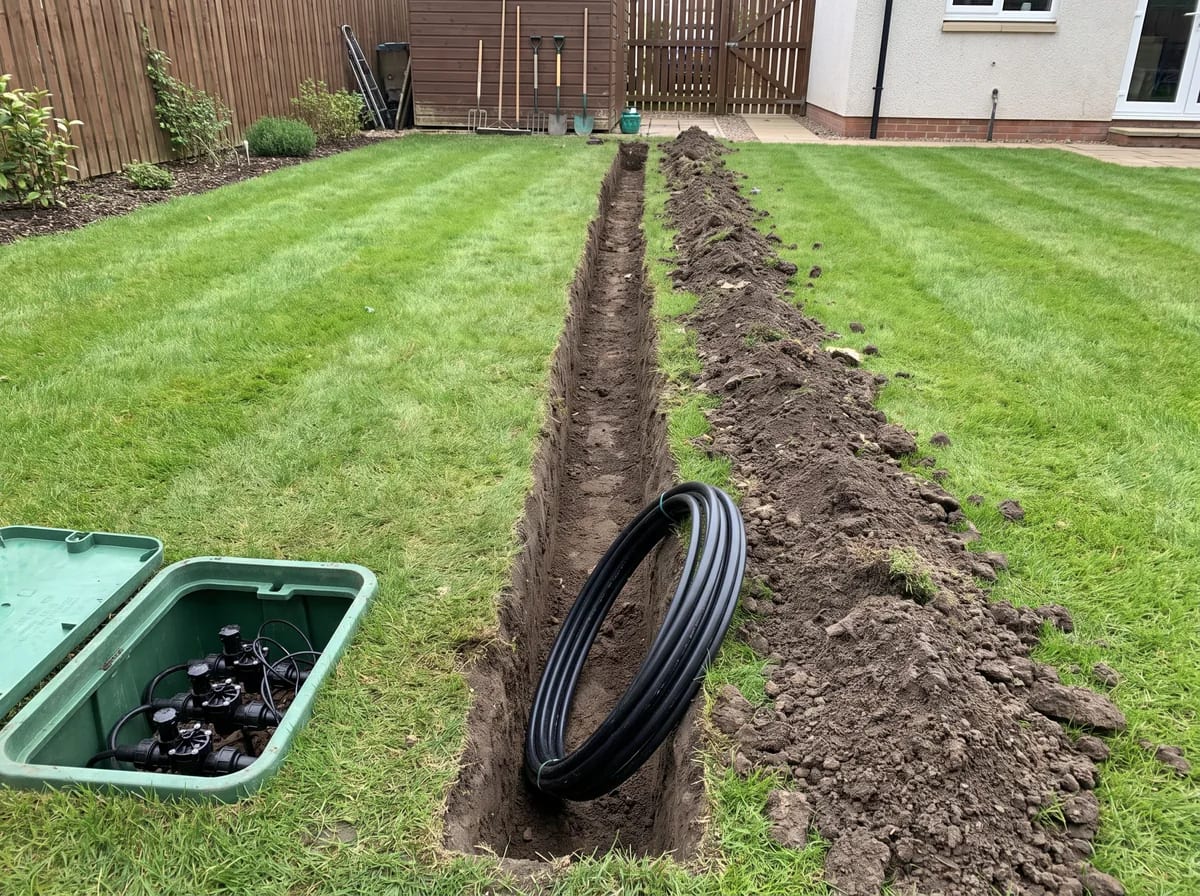
- Trenching and mainline, lateral and valve installation
- Head and nozzle selection with pressure regulation where needed
- Controller installation and initial seasonal programming
Scope varies between contractors. Use this as a baseline when comparing quotes, and ask what is included before agreeing to work.
Questions
Installation in Lakeview Heights
Why is drip so widely used on Lakeview Heights slopes?
Because it addresses the two things working against overhead spray here: slope and evaporation. Drip applies water slowly enough that sloped ground absorbs it rather than shedding it, and it delivers at the root zone instead of losing volume to sun and wind on an exposed east-facing hillside. The vineyards use it for the same reasons the ornamental beds benefit from it.
How many zones does a property need?
It is set by available flow, not by property size. Each zone can only run as many heads as your water supply can serve at their designed pressure, so a property with modest flow needs more, smaller zones than one with strong supply. Planting matters too: turf, shrub beds and trees should be on separate zones because their water needs genuinely differ. A measured flow test at the property is the only way to answer this properly.
How long does installation take?
For a typical residential property, most installations run one to three days once scheduled — a day of trenching and pipe, then heads, valves, controller and commissioning. Larger or acreage properties with long runs, high zone counts or pump work take longer. The lead time before starting is usually the bigger factor, particularly in spring.
Should new beds use drip instead of sprinklers?
In most cases yes, and it is worth specifying at design stage rather than retrofitting later. Drip delivers water at the root zone with far less evaporation and no overspray, which suits shrubs, perennials and trees. Turf still needs overhead coverage. Most well-designed modern systems are hybrids: rotors or sprays on lawn, drip on beds, each on their own zones and schedules.
Free, no obligation
Compare installation quotes for your property
Tell us what your property needs. We pass the details to an independent irrigation contractor serving your area, and they contact you directly.
Prefer email?
Send the details to quotes@kelownairrigation.ca and we route it to the right contractor.
Email quotes@kelownairrigation.caNearby areas
Installation in neighbouring communities.
- Westbank CentreThe relatively flat commercial and residential core of West Kelowna, with gentler grades than the slopes above.
- Shannon LakeGently rolling residential land around Shannon Lake, with moderate grades and a golf-course setting.
- GlenrosaSteep elevated slopes rising well above Westbank Centre, at the interface with surrounding forest and grassland.
- Smith CreekUpper-elevation West Kelowna slopes, steep in places, at the edge of surrounding wildland.
Related services
Often requested alongside installation.
- Drip IrrigationLow-volume systems delivering water at the root zone — the efficient choice for beds, slopes, trees and xeriscaping.
- Sprinkler RepairDiagnosis and repair of broken heads, leaking valves, wiring faults and zones that will not run.
- Backflow TestingTesting and certification of backflow prevention devices protecting drinking water from irrigation systems.
Free quote requests
Compare installation quotes for your property
Tell us what the job involves and we will pass it to an independent irrigation contractor working in your area. Free to request, and you are under no obligation to go ahead.