What Size Air Compressor You Actually Need to Blow Out a Sprinkler System
The specification that matters for a sprinkler blowout compressor is CFM at the pressure your system tolerates — not horsepower, not tank size, and not the sticker on the shelf.
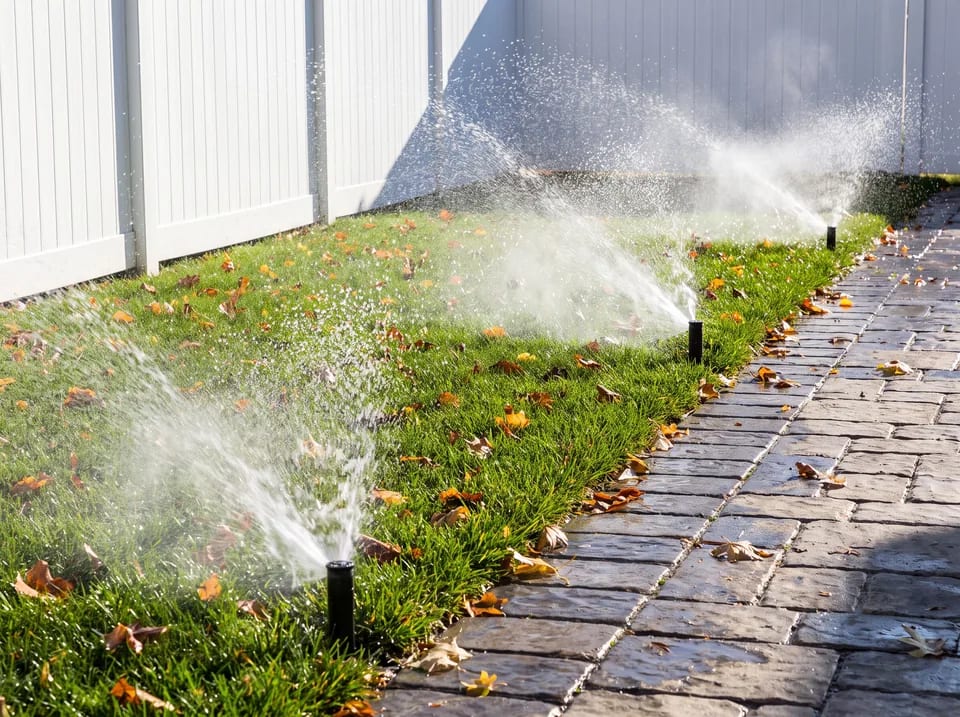
The question most owners ask before trying their first DIY sprinkler blowout is a reasonable one: what size compressor will do the job. The marketing on compressors makes the answer sound simple — horsepower, tank gallons, maximum psi — but none of those are what actually determines whether a compressor can winterize your system. The number that matters is CFM delivered at the pressure your pipe tolerates. That is a smaller number than most of the ratings on the box, and it is the number most under-sized compressors fail on.
CFM at pressure, not peak CFM
Compressors are rated at multiple pressure points, and the delivery drops as the operating pressure rises. A unit rated at six CFM at 40 psi might deliver three and a half CFM at 90 psi. Blowouts happen at the lower pressure band — 50 psi on polyethylene lateral, 80 psi on PVC — so you want the CFM number specifically at those pressures, which is where most spec sheets quietly stop reporting. If the only CFM figure quoted is at 90 psi, assume real delivery at 50 psi is somewhat higher than that figure but not by much.
What tank size does and does not do
A big tank buffers short bursts of demand; it does not increase the compressor's output. A pancake compressor with a thirty-gallon aftermarket tank will run its pump continuously trying to keep up with a residential zone and the tank will drain in seconds. Tank size matters for nail guns; CFM matters for blowouts.
Approximate CFM required by system size
The rough brackets contractors use when sizing their own equipment, translated into the hobby-compressor scale: a small drip-only system or a single modest spray zone can be done with 10 CFM sustained; a standard residential system of six to twelve zones with mixed spray and rotors wants 15 to 25 CFM sustained; a larger residential or small commercial system with twenty-plus zones wants 30 to 50 CFM sustained; and anything on an acreage with pumped supply and long laterals is in the 50 to 100+ CFM range and should not be attempted with a portable rig.
- Drip zones and small single-zone systems: 10 CFM sustained minimum.
- Standard residential six to twelve zones: 15 to 25 CFM sustained.
- Larger residential, mixed types, twenty-plus zones: 30 to 50 CFM.
- Acreage with pump, long mainline, high flow: 50 CFM and up — not a hobby job.
- All numbers above are CFM at the operating pressure, not peak rating.
Why under-sized still looks like it works
The deceptive thing about using a small compressor on a residential irrigation system is that water does come out of the heads nearest the valve. Air pushes water downstream, mist appears, and it feels like progress. What is actually happening is that air of a given volume is clearing the near part of the lateral until it finds the path of least resistance, which is up through a convenient head, and the rest of the zone keeps its water. The furthest heads, which are usually at the end of the longest lateral run, never see the volume of air they would need to push the water in that pipe out. The winterization is partial. The spring tells you so.
Pressure is still a ceiling, even on a right-sized compressor
A towable 185 CFM compressor can hit well over 100 psi at the port if you let it. The regulator between the compressor and the blowout fitting is what keeps the pressure at the lateral below the component ceiling. CFM solves the clearing-volume problem; regulation solves the pressure-damage problem. They are two separate decisions, and both have to be made.
What a contractor actually brings
The honest reason winterization is a service rather than a DIY task for most Kelowna properties is the equipment economics. A towable 185 CFM diesel compressor is a five-figure capital item. A residential customer uses it for forty-five minutes once a year. The service exists because the economics of ownership only work for someone running it across hundreds of properties a season. If you have access to a construction-grade compressor already — some tradespeople do — the DIY route is reasonable. If you are considering buying one for one house, it is not.
The failure the compressor hides
A professional blowout is the moment a contractor sees your system under pressure in reverse. A weeping valve, a cracked lateral masked by soft soil, a backflow assembly starting to leak at the relief port — all show up under air and get flagged for repair before the freeze. That diagnostic is not what you are paying for on the invoice, but it is often what you are getting.
Where this matters in the Okanagan
Hillside systems — Wilden, Dilworth Mountain, upper Glenrosa, parts of McKinley Landing — have longer lateral runs and more elevation per zone, which means more water in the pipe to displace and higher sensitivity to the sequence air moves through it. Acreages with pumped supply have mainline runs measured in hundreds of feet and are entirely outside the hobby-compressor envelope. For those properties specifically the compressor-sizing decision is almost always going to come out the same way. On a flat Lower Mission lot with four zones and good drainage the margin is wider, and DIY is more defensible if the equipment is right.
If you want to know what a professional blowout costs for your property specifically, the quote form on this platform collects a short description of your system and passes it to local contractors who serve your area. Two or three quotes side by side is usually enough to see whether DIY is really saving you anything once you count the compressor rental or purchase, the fittings and the time.