Drip vs Spray Irrigation: Which Belongs Where on an Okanagan Property
Spray for lawn, drip for nearly everything else — and why that split matters more on dry, sloped Okanagan lots than almost anywhere.
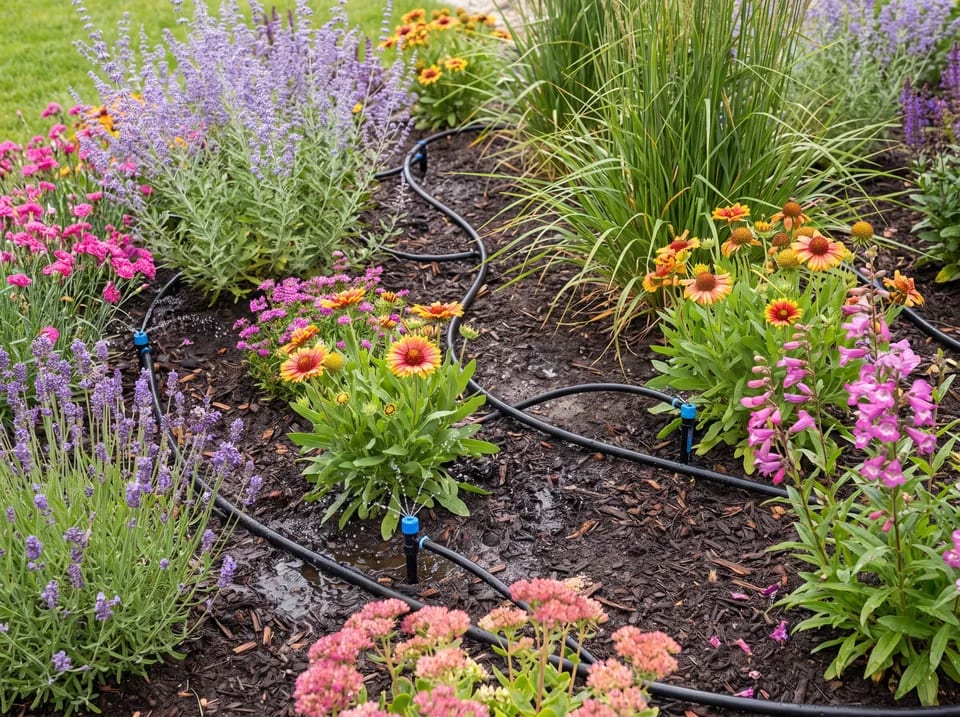
Most well-designed irrigation systems in this region are hybrids: overhead spray or rotors on turf, drip on everything else. That split is not a stylistic preference. It follows from what each method physically does with water, and the Okanagan's dry, sloped, often rock-mulched properties make the difference unusually stark.
What drip does better
Drip applies water slowly and directly at the root zone. That means very little is lost to evaporation or wind, none is thrown onto walkways or fences, and — critically on any slope — the application rate can be kept below what the soil absorbs, so water soaks in rather than running downhill.
- Garden beds, shrub borders and perennial planting
- Trees, on their own schedule with emitters out at the drip line
- Rock-mulched and xeriscaped areas, where spray loses much of its water before it lands usefully
- Sloped planted areas prone to runoff and erosion
- Anywhere overspray onto hardscape or siding is a problem
Where spray still wins
Established lawn. Turf needs relatively even coverage across a continuous area, and overhead heads deliver that efficiently and cheaply. Subsurface drip for turf exists and is used in some commercial settings, but for residential lawn it is expensive, harder to service and rarely worth it.
The mistake that undoes a conversion
Converted drip zones need their own schedule. Drip runs longer and much less often than spray — perhaps an hour once or twice weekly rather than fifteen minutes several times a week. Leaving a converted zone on the turf programme is the most common reason a drip retrofit disappoints.
Why local terrain pushes this harder here
On hillside properties around Wilden, Dilworth Mountain or McKinley Landing, thin soil over bedrock holds very little water, steep grades shed anything applied quickly, and rock mulch drives surface evaporation up. Spray irrigation fights all three at once. On the west side, sun-exposed slopes and genuine watering restrictions produce the same conclusion from a different direction.
The maintenance trade-off, stated honestly
Drip's one real drawback is that emitter openings are small, so anything in the water eventually finds them. Filtration is not optional — particularly on well, lake or agricultural supply — and filters need cleaning several times a season rather than once. With that in place, clogging is a routine task rather than a recurring failure. Without it, a drip system will disappoint within a season.