Irrigation on Okanagan Hillsides: Pressure, Runoff and Rock
Why sloped Central Okanagan lots behave differently, what cycle-and-soak actually does, and when a hillside system needs redesign rather than repair.
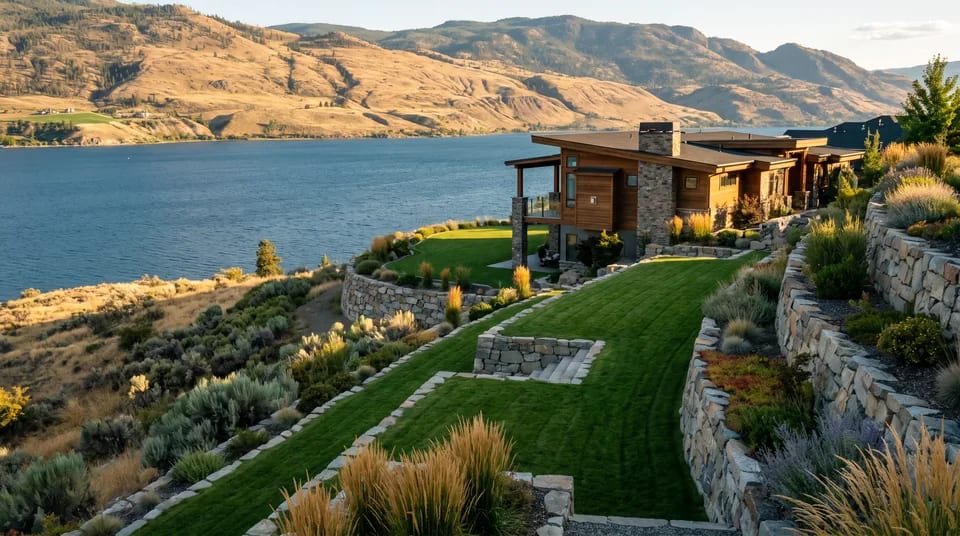
A large share of Central Okanagan properties sit on a slope, and slope changes irrigation in ways that are easy to misread as equipment failure. If you have heads that mist at one end of a zone and barely turn at the other, or water that runs down the driveway during every cycle, the terrain is doing that — not a faulty part.
Elevation is a pressure problem
Water pressure drops roughly one psi for every 2.3 feet of elevation gain. On a terraced lot in Dilworth Mountain or McKinley Landing, a single zone can span twenty feet or more of vertical rise, which means close to nine psi of variation between its highest and lowest head. Sprinkler heads have a designed operating range, and outside it they misbehave in exactly the ways owners report: fine misting when over-pressured, weak throw or stalled rotation when under-pressured.
The fix is not new heads of the same type. It is pressure regulation — either heads with built-in regulators or a regulated valve for the zone — so every head operates where it was designed to.
Zone by elevation, not by convenience
The most consequential decision on a hillside system is made at design stage: grouping heads by elevation band rather than by which part of the yard they happen to be in. A zone spanning a large vertical range cannot be made to water evenly afterwards at any price. This is the main reason some hillside systems need redesign rather than repair.
Cycle-and-soak, and why it is not just shorter watering
On a slope, water applied faster than the soil absorbs it runs downhill and is simply lost. Cycle-and-soak splits one long watering into several shorter cycles with soak time between them. Three ten-minute cycles half an hour apart put substantially more water into the root zone than a single thirty-minute run on the same ground — same total run time, very different result. Most modern controllers do this automatically once configured.
Low-head drainage is not a leak
If water drains out of the lowest head after every cycle, that is water left in the lateral running downhill and exiting at the low point. It wastes water and leaves a soggy spot, but it is not a burst pipe. Check-valve heads or in-line check valves resolve it.
Rock and thin soil change the maths again
On rock-heavy hillside properties — Wilden is the clearest local example — soil depth over bedrock is limited, so the ground holds very little water at any one time. There, run frequency matters more than duration: a long cycle drains past the root zone and is wasted, while short frequent applications keep the small available soil volume in the right range. Rock mulch also raises surface temperature and evaporation, which is why these properties convert to drip more often than any others in the region.
What to ask for on a sloped property
- Pressure-regulating heads or regulated valves on any zone spanning elevation
- Zones grouped by elevation band rather than by area
- Check valves at low points to stop between-cycle drainage
- Cycle-and-soak scheduling configured at commissioning, not left to you
- Drip on terraced, rock-mulched and ornamental areas from the outset