What PSI to Use for a Sprinkler Blowout (and the Pressure That Actually Clears a Line)
The PSI question is where most DIY sprinkler blowouts go wrong — because the number everyone remembers is the wrong one. What actually clears a line is volume, not pressure, and the limits are stricter than they look.
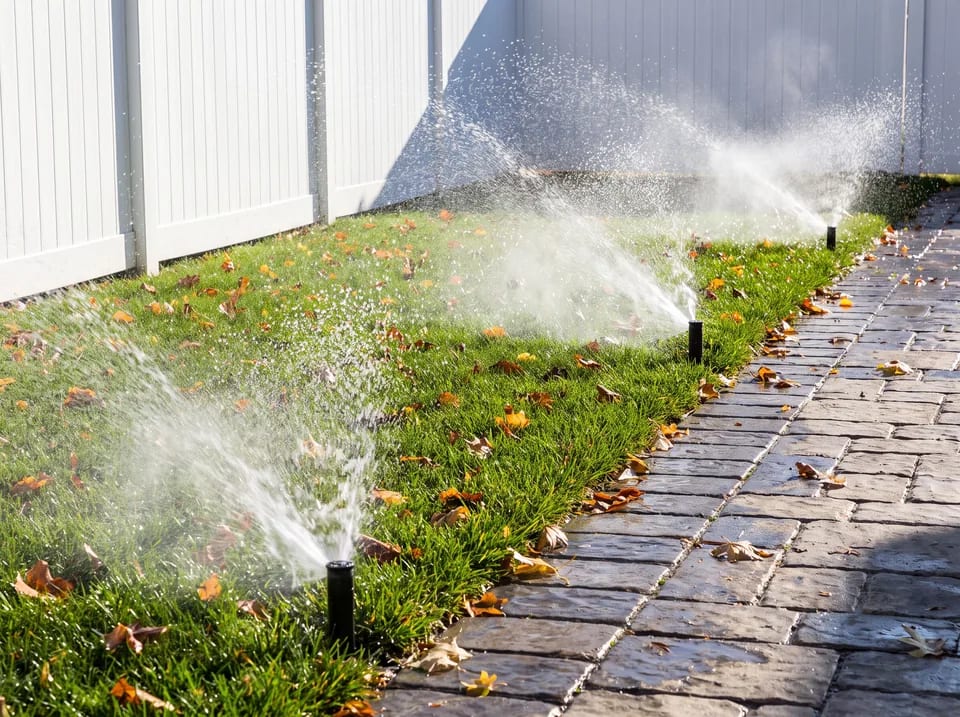
The pressure question is the one that trips up most DIY sprinkler blowouts in Kelowna. People remember a number from somewhere — forty psi, fifty, a hundred — and treat it as the setting that gets the job done. The honest answer is less flattering: pressure is not what clears the line. Volume is. And the pressure ceiling you must respect is lower than most portable compressors deliver at idle.
The number to remember is a ceiling, not a target
Residential irrigation components — polyethylene lateral pipe, PVC fittings, pop-up gear bodies and the rubber seals and risers inside them — are tolerant of normal operating pressure, which sits in the 30 to 80 psi band depending on your supply. They are not tolerant of a sudden pulse at 150+ psi, which is what an unregulated small compressor can hit at the port if you have not told it otherwise. The industry rule of thumb across most residential irrigation manufacturers is to stay at or below 80 psi for PVC lateral and at or below 50 psi for polyethylene lateral. Hit either ceiling and components start taking damage you only discover at spring start-up.
The one setting that matters
Set your regulator so the compressor cannot deliver more than 50 psi at the blowout port on a polyethylene system, and no more than 80 psi on a PVC system. Confirm with a gauge at the port, not at the compressor. The reading at the tank is not the reading at the fitting.
Why volume matters more than pressure
A residential zone pushes a reasonable volume of water when it runs normally — thirty, forty, fifty litres a minute at the heads. To clear that volume with air, you have to deliver roughly the same volume of air, which is why professional blowout rigs run large compressors with high CFM output. A small pancake compressor rated at a few CFM can only push a trickle through the line, so even at the correct low pressure it never actually clears the furthest heads. The water sits there anyway, and the system is not winterized in the way it needed to be.
This is the gap that catches people. A homeowner connects a pancake compressor, sees air at the heads near the valve, pulls the connector when the first mist appears and thinks they are done. The far third of the zone never saw enough air to displace what was in it. A hairline crack in a lateral the following March is the receipt.
A rough CFM ceiling by system size
If the compressor cannot sustain the air output the zone would normally push as water, it cannot winterize that zone properly. Approximate CFM required rises with zone flow — small single-zone drip lines want very little, standard residential rotor zones want 10 to 25 CFM sustained, and larger multi-head commercial zones can want 30 to 80 CFM or more. The twenty-dollar pancake compressor on your bench moves one to three CFM. The gap is not small.
What about the backflow and drip zones
Drip is the component most sensitive to pressure in the whole system. Drip emitters, pressure-compensating lines and the filters attached to them tolerate roughly 25 to 30 psi before they start damaging — well below the lateral ceiling. Any zone with drip on it should be blown out at the lower limit, not the higher one, and that is a case where separate regulator passes for different zone types makes sense. Backflow assemblies have their own freeze considerations covered elsewhere, but the test cocks on them are not blowout ports — do not connect air to them.
The connector is a brass fitting, not an improvisation
The air connector that threads into the blowout port on your mainline is a specific, cheap brass fitting. Attaching an air line directly to a hose bibb through a garden hose is not a shortcut; the hose end often fails under pulse pressure and the connection is not rated for air. If you do not have the right fitting, that is a reason to pause, not improvise.
How a professional blowout actually runs
The service a contractor performs looks different because the equipment is different. A towable compressor delivering 185 CFM at 90 psi can blow out a residential system working zone by zone, keeping the regulator at the correct pressure for the components in each zone, moving air through the system at the volume needed to actually clear it. The zone runs until mist thins to dry air and no further, usually a minute or two per residential zone and a cycle more than once on each. Then the controller is set to seasonal off, drain valves on the backflow and any pump housing are opened, and the job is complete. The pressure never climbs past the ceiling because the regulator does not permit it.
If you still want to do it yourself
Some owners have the right compressor already and are comfortable with the mechanics. If that is you, the short list is: shut off and isolate the supply, drain the backflow, work zone by zone with a regulator in line and a gauge at the port, keep pressure at or below the lower of 50 psi (polyethylene) or 80 psi (PVC), run drip at 25 to 30 psi, run each zone no more than one to two minutes at a time and cycle it twice rather than once, and never leave a zone running dry under air for longer than it takes to clear.
- Isolate and drain the water supply before any air goes in.
- Install a regulator between compressor and blowout port — not optional.
- Confirm the actual pressure at the port with a gauge; tank reading is not it.
- Run drip zones at 25 to 30 psi, laterals at 50 psi (poly) or 80 psi (PVC).
- Cycle each zone twice at short duration rather than once for long.
- Set the controller to off; drain pump, filter and backflow housings.
When to request a quote instead
On any system larger than a few zones, on a hillside property where the elevation of the lowest head differs from the compressor by much, on an acreage with a pump, or on a system where the backflow assembly is complex, the professional service is the honest answer. Contractors are not up-selling when they say the DIY route is risky at scale; they are describing their own tools. If you want a quote on a blowout for your property specifically, this platform collects a short description of what you have and passes it to local contractors in your area so you can compare two or three before deciding — the service pages on winterization have more on what to expect, and the request form is the direct route.