What Actually Happens if You Skip a Sprinkler Blowout
The specific damage freeze does to an unwinterized irrigation system in the Okanagan — where it happens, what it costs to repair, and why some of it does not show up until July.
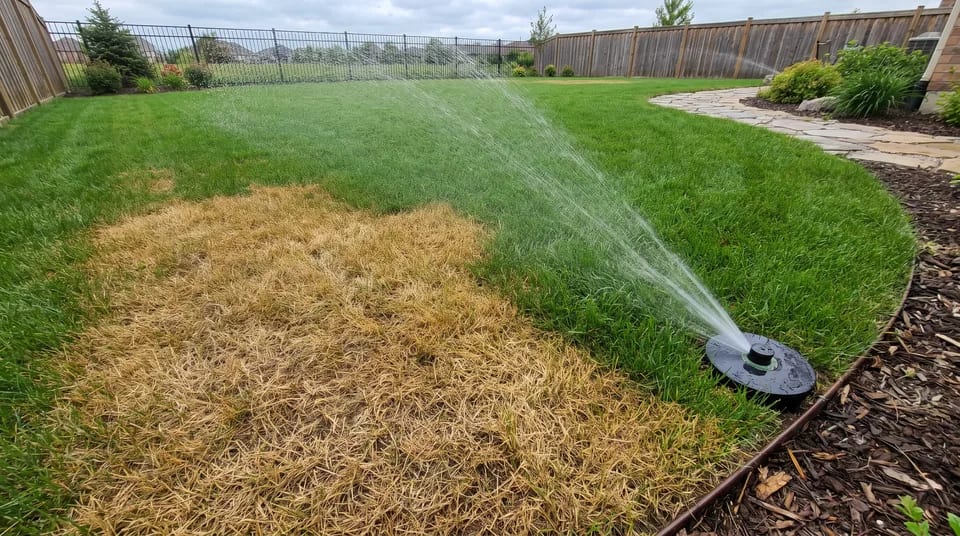
The question comes up every October: what actually happens if I just skip the blowout. The honest answer is that in most years, on most properties, something will break. The variables are which parts break, how expensive those parts are to replace, and how much lawn you have to tear up to reach them. This piece covers what the failures actually look like, in the order they tend to show up, and why some of them stay hidden until midsummer.
Why water left in pipe is the problem
Water expands roughly nine per cent when it freezes. That is not a lot by volume, but it does not matter — the force the ice exerts on whatever contains it is substantial. Rigid PVC fittings crack. Polyethylene lateral splits at the seam. Brass valve bodies fissure. Sealed sprinkler head internals rupture their diaphragms. Backflow assemblies — expensive and above-ground — are the single most exposed component. None of these failures announce themselves until the system is next pressurised, which is usually April or May.
What breaks, in the order it tends to break
- 1The backflow assembly. Above ground, full of water, almost always the first thing to go. A new RPZ assembly runs well into the hundreds of dollars plus labour and testing.
- 2The valve manifold. Brass bodies crack along the ports; plastic bodies at the seam. Replacement is accessible if the manifold is in a valve box; much less so if it is buried under lawn.
- 3Sprinkler heads. Internal mechanisms freeze, split or lose their seals. Heads are cheap individually but if a zone has twenty of them failing after one bad winter, the total is not.
- 4Laterals. Polyethylene splits along its length at the frozen section. Finding the split means digging; sometimes several digs.
- 5The mainline. Rare — the mainline is usually buried below frost line in Kelowna — but on properties where it is shallow or improperly bedded, a split there is a serious repair.
- 6Pump and filter housings on acreage systems. Expensive, and sometimes the whole unit rather than a part.
The failures that hide
Not all freeze damage shows up at spring start-up. A hairline split in a lateral may hold under low pressure in April and only burst under the summer peak pressure of a hot afternoon in July — which is when every contractor is already booked out. A gear-head whose seal failed last winter might still spray but no longer rotate, missing coverage you only notice when the lawn starts browning in August.
What the repair bill tends to look like
On a typical mid-sized residential system that skipped winterization and saw a normal Okanagan freeze, the common repair profile is: new backflow assembly or rebuild kit, two to four replacement heads, a cracked valve body replacement, and possibly one lateral dig. Done at normal pricing in early April that is a bad week. Done as an emergency call in mid-May when every contractor is in peak start-up season, prices are higher and scheduling is harder. The service was cheaper than this.
The non-trivial case: it broke under the lawn
A split lateral is the sneaky expensive failure, because the pipe itself is cheap but reaching it is not. On a mature lawn with established turf and planting over the break, the contractor has to locate the exact failure point, trench to it, replace the section, and restore everything on top. Finding the break is often where most of the time goes — on a slope or near a bed, the water surfaces metres away from the actual split. This is the repair that single-handedly reframes next October's decision for most owners who have experienced it.
The insurance question
If freeze damage results in water surfacing where it causes damage to a building or finished surface — a cracked lateral under a foundation wall that saturates a crawl space, a split line that erodes a retaining wall — some home insurance policies may address the resulting damage. The irrigation damage itself is almost never covered, because it is a maintenance omission. Policies vary and the question is one for your broker, not for an irrigation contractor; but the general shape of the answer is: the water damage, maybe; the pipe repair, no.
The honest exceptions
There is a thin set of properties where skipping blowout does not usually produce damage: pure-drip systems with no overhead spray and no sealed valve bodies, systems with correctly-placed manual or automatic drains that fully clear the laterals by gravity, and systems in warmer climates where the ground does not freeze. The Okanagan does not qualify for the third category; some systems qualify for the first two. The piece on winterizing without a blowout elsewhere on this site goes into which installations those are.
For everyone else, the service is cheaper than the alternative. If you are reading this on October 6 and have not booked yet, that gap is closing — valley bookings fill through October and elevation bookings are already tight. The quote form on this site passes a short description of your property to local contractors who can usually book within a week.