When to Blow Out Sprinklers in the Okanagan
Timing your irrigation blowout for Kelowna's climate — why October is the valley's window, why elevation changes it, and what happens if you leave it too late.
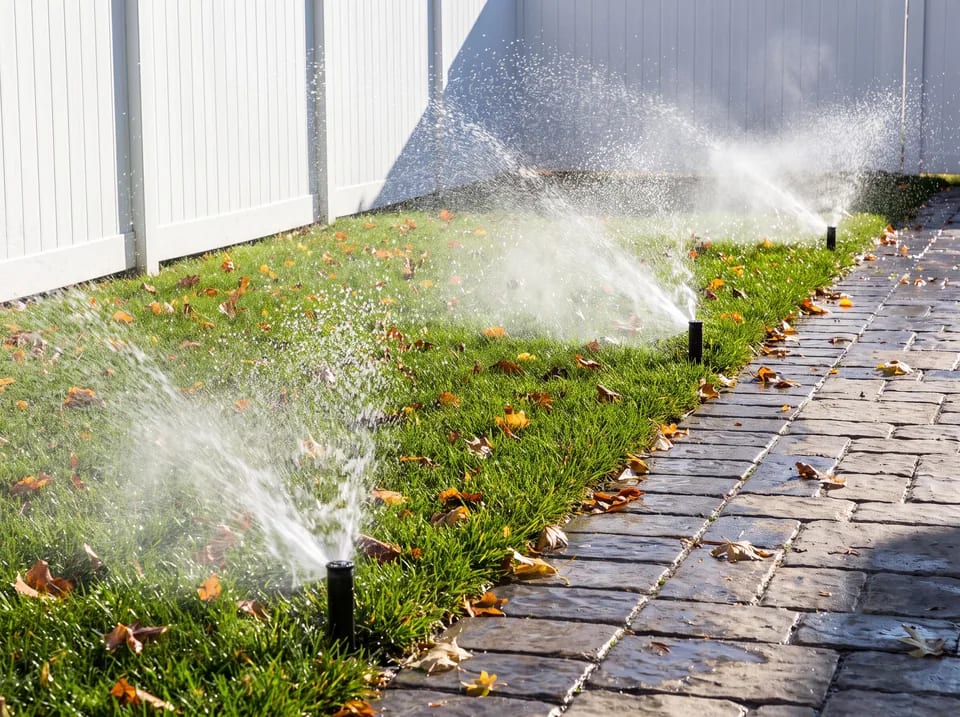
Irrigation winterization is the one seasonal service where timing carries real financial consequence. Water expands as it freezes, and it does not care that it is inside a buried lateral or a valve body. Get the timing right and nothing happens at all. Get it wrong and you find out at spring start-up, when the system will not hold pressure and the damage is under the lawn.
The short answer for the valley floor
For most properties in Kelowna, West Kelowna and Lake Country, the window is October. That is early enough to be safely ahead of the first hard frost in a typical year, and late enough that you have finished watering. Search behaviour reflects this precisely: local blowout searches surge through September and October and then collapse — one Kelowna blowout term we track averages around 50 searches a month but reached 390 in a single October.
The asymmetry that should drive your decision
Being early costs you nothing once you have stopped watering for the year. Being late can cost you cracked laterals, split valve bodies and a damaged backflow assembly. Those are not equivalent risks, so do not treat the decision as though they are.
Elevation changes the answer significantly
The valley-floor window does not transfer upward. Higher ground cools sooner, and the difference is not marginal. Properties on Black Mountain, in upper Glenrosa or Smith Creek, or out toward Joe Rich should plan earlier than someone in Lower Mission. At Big White, sitting at roughly 1,750 metres, hard frost can arrive before the end of September — so a blowout booked on valley timing is already too late.
A rough ordering by elevation
- 1Big White and alpine properties: late summer to very early fall, as soon as watering stops.
- 2Higher-elevation valley areas — Black Mountain, Joe Rich, upper Glenrosa, Smith Creek: early October.
- 3Valley floor — Rutland, Lower Mission, Westbank Centre, Winfield: through October.
Why draining is not enough
This is the most common misunderstanding about winterization. Even with drain valves and helpful grade, laterals and low points retain water that gravity will not shift. It takes very little water in the wrong place to crack a fitting. Compressed air is used because it removes what draining leaves behind — that is the entire reason the service exists in the form it does.
If you are doing it yourself
The main hazard is pressure, and it is easy to get wrong. Volume matters more than pressure for clearing lines, and a compressor sized for running tools can easily exceed what irrigation components tolerate — damaging heads, seals and fittings in the process of trying to protect them. Work zone by zone at low pressure, and do not leave a zone running on air longer than it takes to clear.
- Shut off and isolate the water supply first.
- Work through zones one at a time rather than all at once.
- Keep air pressure low — well below what a tool compressor delivers at full output.
- Use lower pressure again for drip zones; regulators and emitters damage easily.
- Drain the backflow assembly, and any pump, tank or filter housing.
- Set the controller to seasonal off, or shut it down.
Book earlier than feels necessary
In practice, contractor availability tends to be the binding constraint rather than the weather. Everyone books in October, which means the people who requested quotes in September choose their date and everyone else takes what is left. If your property is at elevation, that gap matters even more.