Why Dry Patches Happen (and Why Watering Longer Won't Fix Them)
Persistent dry patches are usually a coverage or pressure problem, not a broken part. Here's how to tell the difference before you pay for repairs.
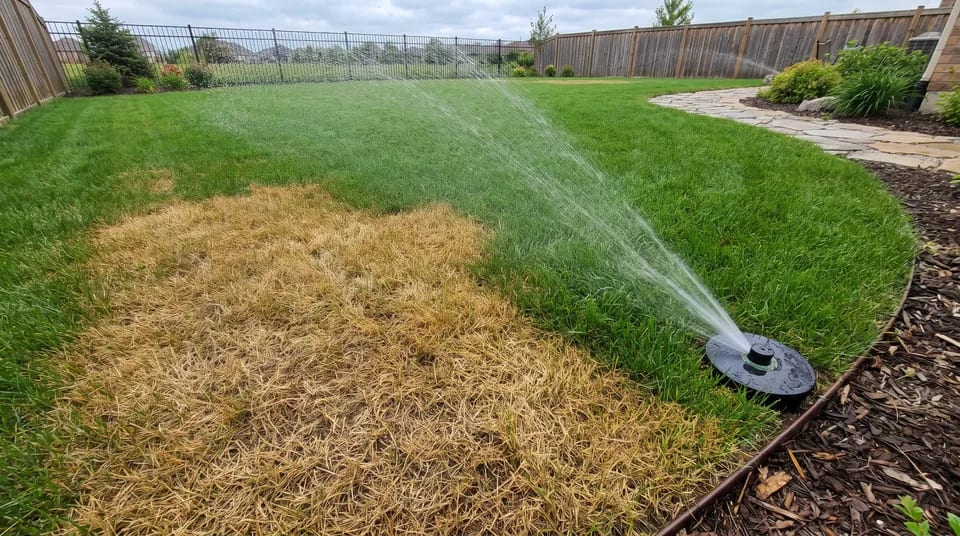
A brown patch that survives everything you throw at it is the most common irrigation complaint there is. It is also the one most often misdiagnosed — usually as a broken sprinkler, occasionally as a lawn disease, and most expensively as a reason to water everything for longer.
The head-to-head principle
Sprinklers are designed so each head's spray reaches the heads next to it. That overlap is not wasteful; it is what produces even coverage, because output falls off toward the edge of a head's throw. When spacing is too wide — or when something blocks the spray — the ground between heads receives noticeably less water than the ground near them. No run time fixes that geometry.
The test that settles it
Put several straight-sided containers around the dry patch and out into the healthy lawn, run the zone for fifteen minutes, then compare depths. If the containers in the dry area hold much less water, you have a coverage problem, not a thirsty lawn.
Four causes worth checking before you buy parts
- 1Mature planting blocking spray that used to carry — very common on established lots where shrubs have filled in since installation.
- 2Mixed head or nozzle types on one zone, applying water at genuinely different rates, so the zone has to run long enough for the driest spot and overwaters everywhere else.
- 3Heads that have settled below grade over the years and are now spraying into the turf rather than over it.
- 4Pressure too low for the head's design range — which on any sloped lot is often just elevation change within the zone doing exactly what physics predicts.
Why watering longer makes things worse
Extending the run time to rescue a dry patch waters everything else more too. On flat, moisture-retentive ground that produces soggy areas, shallow rooting and thatch. On a slope it mostly produces runoff. Either way you have raised your water bill without addressing the actual cause, which is that the system is not distributing water evenly.
The good news about cost
Uniformity problems are usually among the cheapest irrigation faults to correct, because they rarely involve pipe. Matching nozzles within a zone, raising settled heads onto swing joints, adjusting arcs and adding pressure regulation are all surface-level work. The diagnosis is the valuable part — which is why it is worth having someone run each zone and watch it rather than replacing parts speculatively.