Can You Winterize a Sprinkler System Without a Blowout?
On most Okanagan properties the answer is no — but it is worth understanding why, because the exceptions are specific and the people they apply to deserve a real answer rather than a sales pitch.
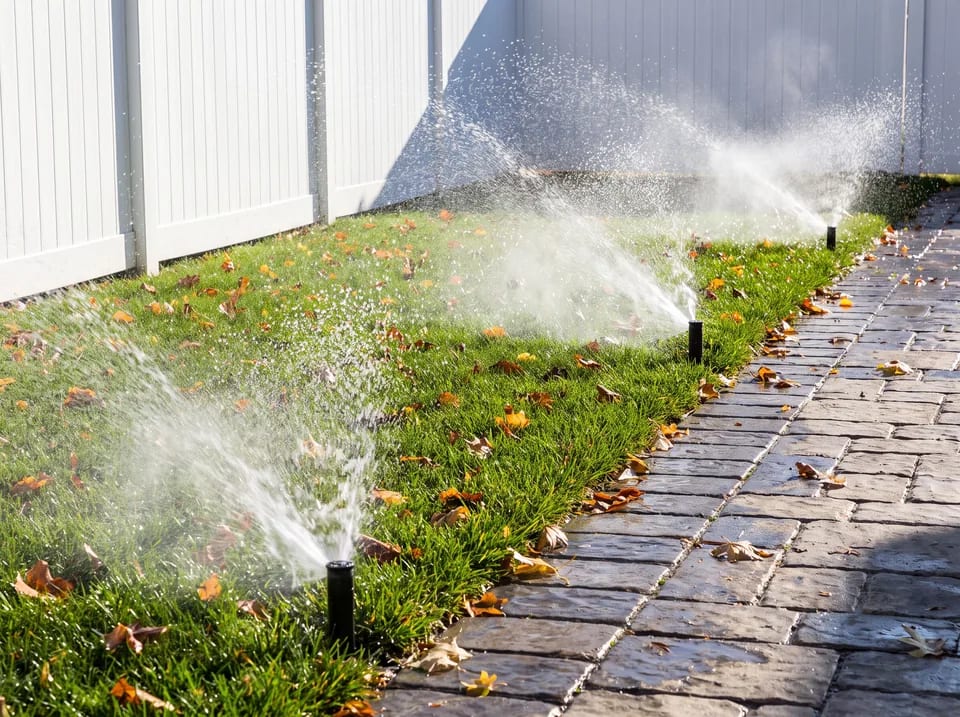
The question is a reasonable one and it does not have a one-word answer. Winterizing a sprinkler system without a blowout is physically possible on some systems, inadvisable on most, and impossible on a specific class of them. The honest answer depends on how your system is designed, where you live, and what you are prepared to accept as the cost of being wrong. The default sales pitch is to blow it out either way, which is right for most properties — but not for all, and it is worth knowing which category you are in.
The three winterization approaches
- 1Manual drain. Open the manual drain valves at the system's low points and let gravity remove water from the laterals. Works only on systems designed with manual drains in the right places and with sufficient grade to the drains.
- 2Automatic drain. Each zone contains automatic drain valves at low points that open when system pressure drops. Works only on systems installed with auto-drains at every low point, which is a design choice older systems sometimes made and newer ones rarely do.
- 3Compressed air blowout. Mechanical removal of water from laterals using regulated compressed air. Works on any system and is the only approach that works on most of them.
Why blowout is the default
Both drain-only approaches require that water can reach a low point and leave through a specifically-placed opening. On a system that was not designed with that in mind — most modern residential systems — water pools in the low spots of the laterals and in the valve bodies regardless of how long you leave the drains open. Those pooled low spots are exactly where freeze damage happens.
When manual drain actually works
If your system was installed with manual drain valves at the low point of every lateral and at the manifold, and your laterals are pitched slightly toward the drains, draining is a legitimate alternative to a blowout. This describes a particular era of system design — a few decades back and in specific climates where blowout equipment was uncommon — and some installations in the Okanagan still have it. The simplest way to check is to walk your valve manifold and look for small manual drain cocks on each zone's downstream side; if they are not there, your system was not designed around manual drain.
When automatic drain works
Automatic drain valves — small weighted valves that open when line pressure drops — were used on some older systems. They work by releasing water from the lowest point of each lateral once the pressure in the pipe falls below their threshold. They can be effective when installed correctly, but on a system where they were installed incompletely, you have the worst of both worlds: water drains from the spots that have drains, and sits in the rest. If you have auto-drains, confirm there is one at every low point. If any zone has even one low point without a drain, the system still needs a blowout.
The pure-drip exception
A system with only drip lines, pressure-compensating emitters and polyethylene tubing is more freeze-tolerant than one with gear-driven pop-ups and sealed valve bodies. Drip tubing can tolerate some trapped water in freeze cycles without damage; emitters are less expensive to replace when they do fail, and a backflow is often the only piece worth insulating separately. Pure-drip systems can sometimes be winterized by draining and isolating only, particularly in protected microclimates. This is a narrower exception than it sounds like, and most homes have at least some overhead spray or rotor zones mixed in with their drip — which puts them back in the blowout category.
The one thing you still need to drain, every time
The backflow assembly. It sits above ground, it is full of water, and it is the single most-expensive-to-replace component on a residential irrigation system. Even on a system you are confident does not need a blowout, the backflow needs to be drained for winter — opened at the bleeder, with the handles turned part-way to break the seal, and the test cocks pointed downward.
What to do if you are not sure
A one-time inspection by a contractor who can tell you what your system actually is — and whether draining will cover it — is the lower-risk version of the no-blowout path. Hire the compressor for one winter if you want, and then genuinely know whether draining alone is viable on your property. For most Okanagan homes, blowout is the right answer. For a smaller number of homes, there is a legitimate alternative. The quote form on this platform collects enough information for a contractor to tell you which category you are in before you commit.
The elevation note
At elevation — Big White, Joe Rich, Black Mountain, upper Glenrosa — the freeze cycle is longer and deeper than on the valley floor. The margin for error on a drain-only approach is smaller there. Any assumption about trapped water that would be benign in Lower Mission is less safe at elevation, where overnight temperatures stay below zero for weeks at a time once winter arrives. If you are at elevation and considering a no-blowout approach, think of it as a decision that would be reasonable in a warmer climate and ask whether yours qualifies.